Newsletter Subscribe
Enter your email address below and subscribe to our newsletter

 ByJohn A
Moisture control is an essential part of plastic processing, particularly when manufacturers work with hygroscopic polymers. These materials can absorb moisture from the surrounding environment, allowing water vapour to penetrate into the core of the polymer granules. If this moisture is not adequately removed before processing, it can affect material properties, surface quality, dimensional consistency, and overall processing performance. Bry-Air identifies polymers such as Nylon, PET, PC, TPU, TPE, PBT, POM, and ABS among materials that may require controlled drying before processing.
A plastic dryer machine provides a controlled drying environment by supplying dehumidified air to moisture-sensitive plastic materials. Unlike basic hot-air drying, desiccant drying focuses on reducing the moisture content of the process air so that it has a greater capacity to remove moisture from the resin. This makes controlled drying particularly relevant for precision plastic processing where consistent material preparation is important.
The objective is not simply to heat plastic granules. Effective drying requires appropriate temperature, airflow, drying time, and dew point according to the material being processed. These parameters should be established using the polymer manufacturer’s specifications and the requirements of the particular processing operation.
Hygroscopic polymers can absorb moisture from humid surroundings during storage, transportation, handling, and processing preparation. Because the moisture can penetrate into the core of the material, surface-level heating may not always be sufficient to achieve the required moisture condition.
Bry-Air explains that hygroscopic polymer drying requires high concentrations of low-dew-point air to remove moisture from inside the granules. The difference in vapour pressure helps drive moisture from the material into the dry air stream.
This makes the drying environment an important part of resin preparation. If the surrounding process air contains too much moisture, the drying process may become less effective and more difficult to control.
Moisture remaining in polymer granules can contribute to processing and product-quality problems. When wet material is heated during plastic processing, the moisture can convert into steam. This can interfere with the polymer structure and may contribute to reduced physical properties and poor surface finish.
Depending on the polymer and processing conditions, inadequate drying may also contribute to visible defects, inconsistent processing behaviour, and reduced mechanical performance. Therefore, moisture management should be treated as a controlled production parameter rather than an optional preparation step.
Dew point indicates the amount of moisture present in air. Lower-dew-point air contains less water vapour and therefore creates stronger conditions for removing moisture from hygroscopic materials.
Desiccant drying technology uses moisture-adsorbing media to reduce the humidity of the process air before it comes into contact with the resin. The dry air then passes through the material and draws moisture away from the polymer. Maintaining an appropriate dew point can therefore provide more consistent drying conditions than relying on ambient air.
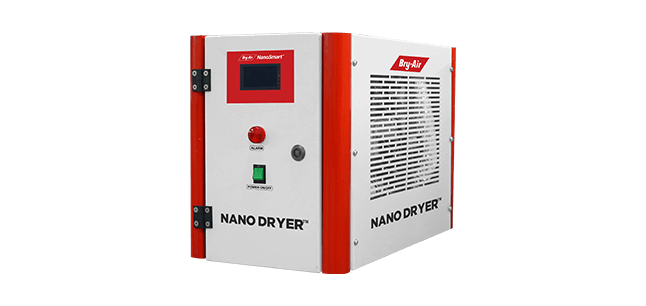
Bry-Air’s Nano Dryer is designed for low-throughput applications and can provide process air at very low dew points. The current product information describes the Nano Dryer as a compact, waterless desiccant dryer designed for precise moisture control in speciality engineering polymers.
Drying performance depends not only on the humidity of the air but also on how effectively that air moves through the material. Adequate airflow helps maintain contact between the dry process air and the polymer granules.
If airflow is insufficient, moisture removal may become inconsistent. On the other hand, airflow should be appropriately matched to the dryer and material-handling arrangement. The correct balance depends on the dryer design, resin type, material quantity, drying temperature, and required moisture level.
The first consideration should be the type of polymer being processed. Different engineering plastics have different moisture absorption characteristics and drying requirements. Nylon, ABS, PC, PBT, POM, PET, and other speciality polymers should not automatically be treated using identical drying conditions.
The resin manufacturer’s technical data should be used to establish the appropriate drying temperature, residence time, dew point, and final moisture requirement. This provides a technical basis for selecting drying equipment rather than relying on general settings.
Bry-Air offers different plastic auxiliary drying solutions for different capacities and polymer requirements. Its product portfolio includes Nano Dryers as well as larger resin drying systems, allowing equipment selection to be matched more closely with the processing requirement.
Dryer capacity is another important consideration. Equipment should be capable of handling the required quantity of resin without compromising the drying conditions.
The Bry-Air Nano Dryer is specifically designed for low-throughput applications. The company states that its Nano Dryer provides a handling capacity of approximately 6 to 12 kg per hour and is available in 15 and 25 CMH models.
For larger production requirements, a higher-capacity drying system may be more appropriate. Selecting equipment based on actual material consumption helps avoid both inadequate drying capacity and unnecessary equipment sizing.
Production-floor space can be a significant consideration for small and precision processing operations. A compact plastics dryer can help manufacturers manage resin drying requirements without occupying unnecessary production-floor space. Conventional auxiliary equipment may require additional floor area and utility connections, which can complicate equipment placement.
The Nano Dryer is designed to mount directly on the hopper, providing a compact configuration that does not require additional floor space for a separate dryer cabinet. Bry-Air describes this as a zero-footprint design for applications where compact installation is important.
This configuration can simplify the overall equipment arrangement while keeping the drying system close to the material inlet of the processing machine.
Utility requirements should also be considered during equipment selection. The Nano Dryer is designed as a waterless system and does not require a cooling water connection. This can simplify installation for applications where access to cooling water is limited or where a compact self-contained solution is preferred.
However, waterless operation should be considered alongside other requirements such as material throughput, drying temperature, dew point, and polymer characteristics.
Moisture can influence the behaviour of polymers during processing. For moisture-sensitive materials, controlling resin moisture before melting helps create more predictable processing conditions.
Bry-Air notes that insufficient removal of core moisture can contribute to reduced physical properties and poor surface finish.
Proper drying therefore supports more consistent material preparation. It can help manufacturers maintain the conditions required for the polymer to perform according to its intended characteristics.
Surface appearance is another important consideration. Excess moisture can contribute to unwanted marks, bubbles, streaks, or other processing defects depending on the material and manufacturing method.
Controlled drying helps reduce the likelihood of moisture becoming a source of variation during processing. However, drying is only one part of overall quality control. Material storage, handling, machine settings, mould conditions, temperature, and processing speed must also be controlled appropriately.
Dew point monitoring provides useful information about the condition of the process air. Consistent monitoring can help operators verify whether the dryer is operating within the required range.
Bry-Air’s Nano Dryer includes precise dew point control and offers a digital dew point meter as an option.
This type of monitoring can be particularly useful where moisture-sensitive engineering polymers require consistent drying conditions.
Modern drying equipment should also provide appropriate control and monitoring functions. Temperature inputs, fault indication, control interfaces, and communication options can help operators manage the drying process more effectively.
Bry-Air lists features such as RTD inputs, digital inputs, isolated outputs, RS485 communication, MODBUS RTU, and optional connectivity for its Nano Dryer.
The appropriate level of automation depends on the production environment and the degree of process monitoring required.
Operators should monitor the parameters that directly influence drying performance. These can include dew point, temperature, airflow, material throughput, and drying time.
Changes in these conditions can indicate that the equipment or material-handling process requires attention. Regular monitoring also helps establish a consistent operating routine.
Drying does not eliminate the need for proper material handling. Once resin has reached the required moisture condition, it can potentially absorb moisture again if it remains exposed to humid surroundings.
Storage containers, conveying systems, hopper arrangements, and transfer processes should therefore be evaluated as part of the overall moisture-control strategy. The objective is to maintain the required material condition from drying through processing.
Selecting drying equipment requires an evaluation of the complete processing requirement. Polymer type, moisture sensitivity, production throughput, required dew point, drying temperature, residence time, installation space, and utility availability should all be considered.
A compact system may be appropriate for low-throughput precision processing, while larger production environments may require higher-capacity resin drying equipment. The most suitable configuration should always be determined from the polymer manufacturer’s requirements and the actual operating conditions.
Bry-Air’s plastics auxiliary equipment portfolio covers different drying capacities and applications, allowing manufacturers to evaluate solutions according to their specific processing needs.
Moisture control plays an important role in processing hygroscopic engineering plastics. When moisture penetrates into polymer granules, simply heating the material may not provide the controlled conditions required for effective drying. Desiccant technology provides a more precise approach by supplying low-dew-point air that can remove moisture from the material before processing.
Choosing the right dryer requires careful consideration of polymer characteristics, production throughput, dew point, drying temperature, airflow, installation requirements, and material-handling practices. Compact waterless systems can provide practical advantages for low-throughput and precision processing applications where space and utility requirements are important.
Manufacturers looking to evaluate their polymer drying requirements can Contact Us to discuss the appropriate drying technology, capacity, and operating conditions with Bry-Air’s technical team.