
Newsletter Subscribe
Enter your email address below and subscribe to our newsletter

 ByJohn A
Non-ionic surfactants play an important role in industrial formulations by helping improve wetting, emulsification, dispersion, solubilization, and surface control. However, not all non-ionic surfactants behave the same way. EO PO Block Copolymers offer a distinctive molecular structure that can provide formulation flexibility under demanding processing conditions.
Understanding the differences between EO-PO block copolymers and conventional nonionic surfactants can help formulators select a suitable surfactant system for industrial applications.
What Are EO PO Block Copolymers?
EO PO Block Copolymers are non-ionic surfactants consisting of blocks of ethylene oxide
(EO) and propylene oxide (PO). Their molecular structure can be designed with different EO-to-PO ratios and block arrangements, allowing manufacturers to develop products with specific hydrophilic and hydrophobic characteristics.
The EO portion generally contributes water affinity, while the PO portion provides comparatively greater hydrophobic character. By adjusting these blocks, EO-PO surfactants can be tailored for different formulation and processing requirements.
What Are Conventional Non-Ionic Surfactants?
Conventional non-ionic surfactants include several widely used classes such as ethoxylates, fatty alcohol ethoxylates, alkyl phenol ethoxylates, sorbitan esters, and polysorbates.
These surfactants contain hydrophilic and hydrophobic portions that allow them to interact with interfaces between materials such as oil and water. They are widely used because they can provide effective emulsification, wetting, detergency, and dispersion without carrying an electrical charge.
Their performance, however, depends significantly on molecular structure, HLB characteristics, concentration, temperature, and the other ingredients present in the formulation.
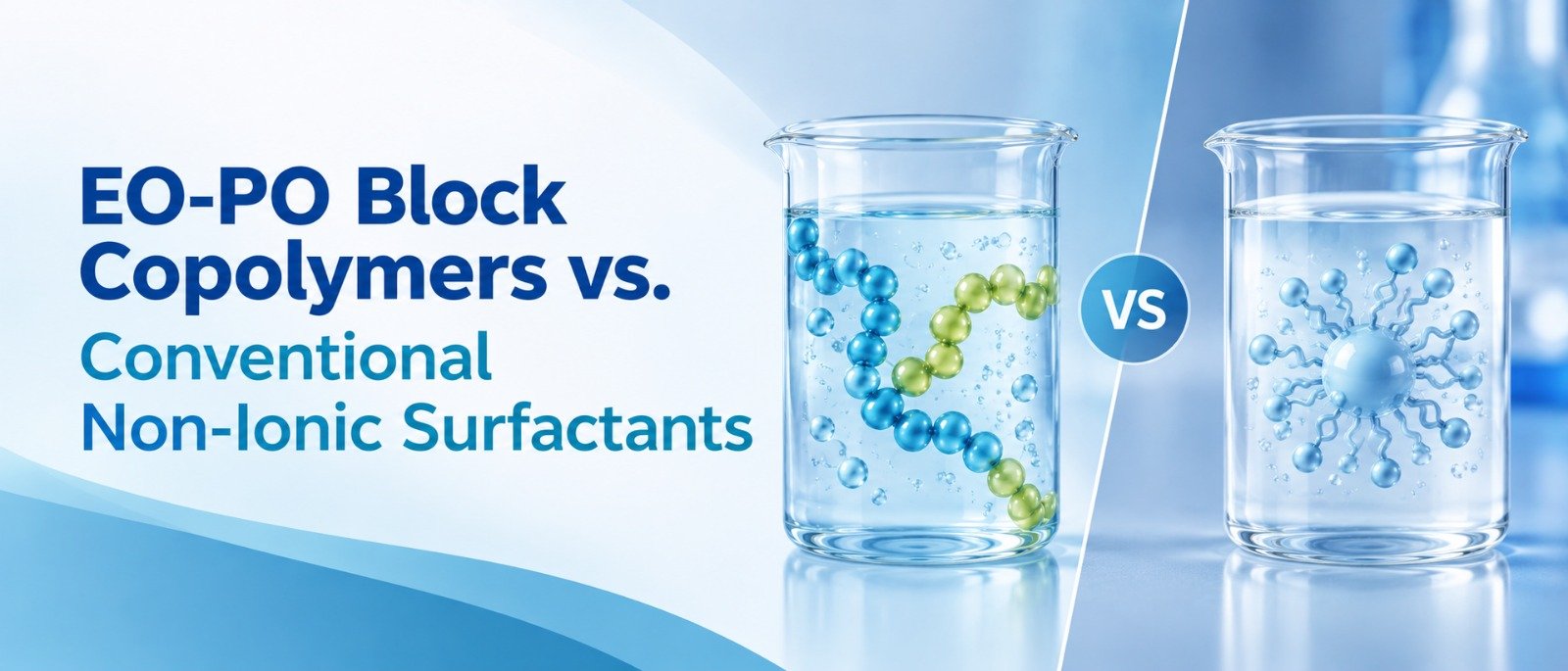
One of the main differences between EO PO Block Copolymers and conventional non-ionic surfactants is their molecular architecture.
Conventional non-ionic surfactants often have a relatively defined hydrophilic group attached to a hydrophobic chain. EO-PO block copolymers instead contain distinct EO and PO blocks.
This block structure allows formulators to select products with different balances of water and oil affinity. As a result, EO-PO block copolymers can offer formulation characteristics that may be difficult to achieve with a single conventional surfactant.
Conventional Non-Ionic
| Property | EO PO Block Copolymers | Surfactants |
| Molecular structure | EO and PO blocks | Various structures and functional groups |
| Surface activity | Tunable through EO/PO balance | Depends on surfactant chemistry |
| Wetting | Can provide controlled wetting | Widely used for wetting applications |
| Emulsification | Useful in selected industrial systems | Broadly used across formulations |
| Foam behavior | Can be tailored for low- or controlledfoam systems | Varies considerably by chemistry |
| Formulation flexibility | High due to adjustable block structure | Depends on the specific surfactant |
Foam can be beneficial in some applications but problematic in others. Excessive foam can reduce processing efficiency, interfere with filling operations, and create difficulties in industrial cleaning and manufacturing systems.
Certain EO PO Block Copolymers are designed to provide low-foaming or controlledfoaming characteristics. This can make them useful in applications where high foam generation is undesirable.
By comparison, conventional non-ionic surfactants can exhibit different foaming profiles depending on their chemical structure and formulation conditions. Therefore, formulators need to evaluate foam behavior rather than assuming that every non-ionic surfactant will perform similarly.
EO-PO block copolymers can be considered for a variety of industrial applications, including:
Their performance can be particularly relevant where controlled wetting, emulsification, dispersion, or foam characteristics are required.
How Should Formulators Choose Between Them?
There is no universal surfactant that is suitable for every formulation. Selection should begin with the specific performance requirement.
Formulators should consider:
Required HLB: Determine the hydrophilic-lipophilic balance required by the formulation.
Foam profile: Identify whether high, moderate, low, or controlled foam is desirable.
Temperature: Evaluate surfactant performance under actual processing and storage temperatures.
Compatibility: Check interactions with solvents, oils, polymers, salts, and other formulation ingredients.
Concentration: Determine the optimum concentration through laboratory testing rather than relying solely on theoretical calculations.
Stability: Assess phase stability, viscosity, appearance, and performance during accelerated and real-time stability testing.
See also: The Future of Business: Trends Shaping the Next Decade
What are EO PO Block Copolymers?
EO PO Block Copolymers are non-ionic surfactants made from blocks of ethylene oxide and propylene oxide. Their molecular structure can be tailored to provide different hydrophilic, hydrophobic, wetting, emulsification, and foam-control characteristics.
Are EO PO Block Copolymers non-ionic surfactants?
Yes. EO-PO block copolymers are a class of non-ionic surfactants because they do not carry a permanent electrical charge.
How are EO PO Block Copolymers different from conventional surfactants?
Their key distinction is their EO-PO block structure. This structure allows the balance between hydrophilic and hydrophobic properties to be adjusted for particular formulation requirements.
Which is better: EO PO Block Copolymers or conventional non-ionic surfactants?
The appropriate choice depends on the formulation. EO-PO block copolymers may be useful where specific wetting, emulsification, dispersion, or foam-control characteristics are required, while conventional non-ionic surfactants remain suitable for many established formulation systems.
Both EO PO Block Copolymers and conventional non-ionic surfactants have important roles in industrial formulation chemistry. The key difference lies in their molecular architecture and the resulting performance characteristics.
EO PO Block Copolymers provide formulators with a versatile platform for controlling properties such as wetting, emulsification, dispersion, and foam. Conventional non-ionic surfactants, meanwhile, offer a broad selection of established chemistries for diverse industrial applications.
The right choice ultimately depends on the formulation’s raw materials, processing conditions, target performance, and stability requirements. Laboratory evaluation and application-specific testing remain essential for selecting the most suitable surfactant system.
